2026-08-28 ·
French Drains for Clay Soil Conditions Around San Bernardino
# French Drains for Clay Soil Conditions Around San Bernardino
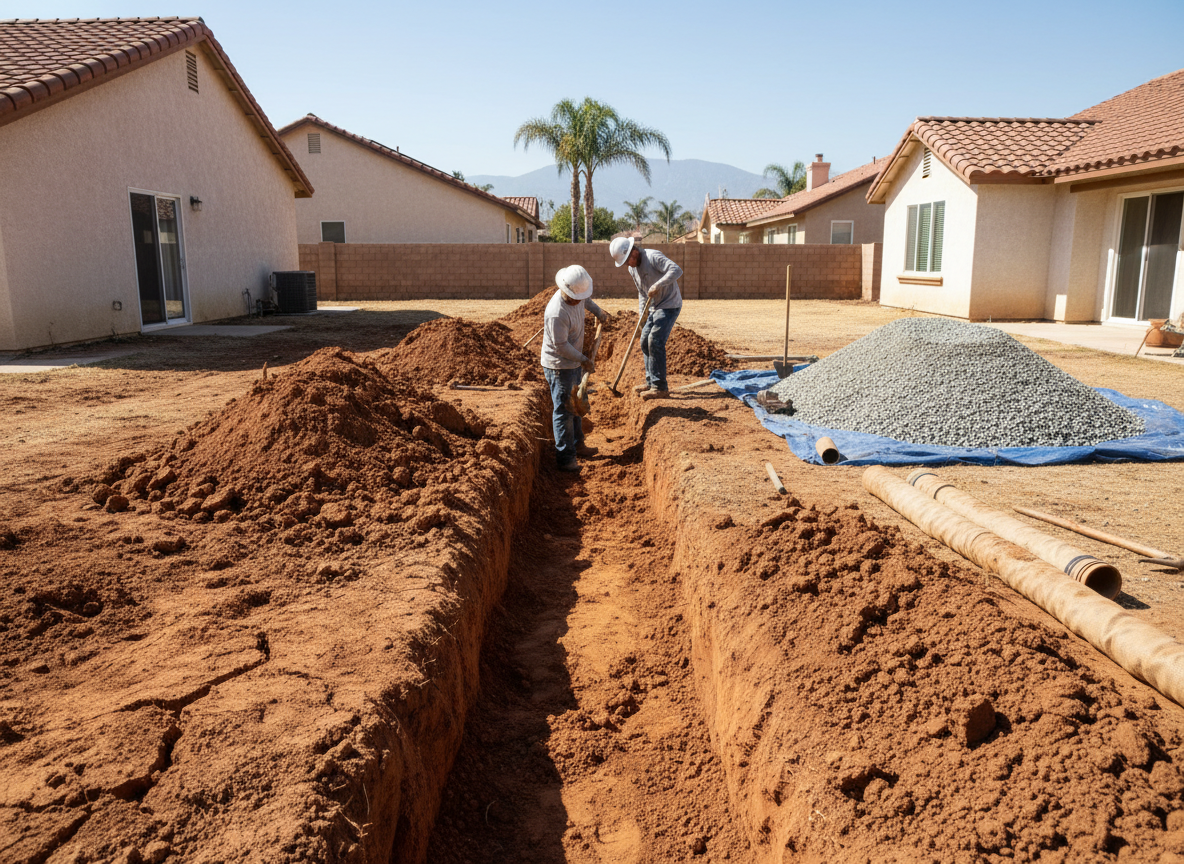
French drains can work well in clay soil around San Bernardino, but the system must intercept water before it reaches a foundation or low spot and carry it to a valid discharge point. A typical residential drain uses a 4-inch perforated drainage pipe, a trench roughly 12–24 inches deep, washed angular stone and nonwoven geotextile fabric. The pipe generally needs a continuous fall of about 1%, or approximately 1/8 inch per foot, where the site allows. Clay absorbs water slowly, so a shallow gravel trench with no reliable outlet often becomes a buried holding basin rather than a functioning drain.
Why Clay Changes the Drainage Plan
Clay-rich ground has small pore spaces, which means water moves through it much more slowly than through sandy or gravelly soil. After a dry period, the surface can also become hard and compacted. When a strong storm arrives, water may travel across the yard toward patios, stem walls and low planting beds instead of soaking in evenly. San Bernardino’s hot desert climate intensifies that contrast: very hot summers dry and harden exposed ground, while seasonal rain can produce concentrated runoff over a short period.
Conditions still vary from lot to lot across San Bernardino County. Established properties around Downtown San Bernardino, Del Rosa and Muscoy may have compacted fill, older landscape changes or roof drainage that has been redirected several times. Near Arrowhead and Verdemont, slope runoff can be more important than standing water on a flat lot. Soil should therefore be checked in several locations; finding clay in 1 test hole does not prove the entire drainage route has the same profile.
Where a French Drain Should Go
The best trench location is usually upslope of the area being protected, not directly beside the wettest wall after water has already arrived. On a sloping property near Verdemont or California State University San Bernardino, a cross-slope interceptor drain may capture subsurface flow before it reaches a patio or foundation. On flatter lots in Downtown San Bernardino or Muscoy, correcting a surface depression and extending downspouts may matter as much as the underground drain.
Before excavation, trace how water moves during an actual storm and identify the proposed outlet. Useful placement checks include:
- Keep the trench outside any footing zone unless the design specifically addresses foundation drainage.
- Avoid trapping water between the drain and the building.
- Confirm that the route will not cross utilities, major roots or irrigation lines.
- Preserve positive surface grading away from the structure.
- Send discharge only to a lawful location where it will not affect a neighboring property.
A drainage system inspection can distinguish groundwater seepage from roof runoff, irrigation leakage or a simple grading defect before trenching begins.
Building the Trench for Slow-Draining Soil
In clay, filtration and a continuous outlet are more important than making the trench unnecessarily deep. The trench should be excavated to a consistent grade, then lined with nonwoven geotextile fabric that separates native soil from the stone while allowing water through. Washed angular drain rock creates open voids around the pipe; soil, pea gravel containing fines or unwashed aggregate can migrate into those voids and reduce capacity.
For most residential applications, a 4-inch perforated drainage pipe provides a practical balance between capacity and serviceability. The perforations, pipe orientation and fittings should follow the selected pipe manufacturer’s system rather than a one-size-fits-all rule. Cleanouts at direction changes or long runs make future flushing possible. The fabric should wrap over the stone before the surface layer is restored, preventing clay from washing down from above.
Professional French drain installation should also account for trench access, spoil removal and elevation at the outlet. A perfectly assembled trench cannot drain by gravity if its discharge point sits higher than the pipe.
French Drain, Catch Basin or Sump Pump?
A French drain is designed to collect water moving through soil and gravel, so it is not always the right answer for fast surface runoff. If water pours from a downspout or crosses concrete during a storm, a catch basin or solid pipe may capture that concentrated flow more effectively. Connecting large roof flows directly into a perforated French drain can overload the gravel trench and release water beside the area it was meant to protect.
Where no gravity outlet exists, a sump basin and pump may be necessary, but that introduces electrical, maintenance and discharge considerations. In some yards, the correct system combines surface grading, catch basins, solid conveyance pipe and a separate French drain. This is especially relevant near foothill-facing parts of Arrowhead, where elevation changes can accelerate runoff, and on flatter parcels toward Colton, where outlet fall may be limited.
For foundation-specific planning, review protecting San Bernardino foundations from rainwater runoff. The goal is not to install the most components; it is to match each type of water to the right collection method.
Warning Signs of a Poor Clay-Soil Installation
A newly installed drain should not leave persistent puddles directly over the trench or discharge muddy water from its outlet. Those symptoms can indicate inadequate slope, an obstructed outlet, contaminated stone or filter fabric that is unsuitable for the soil. Settlement along the trench may also redirect surface runoff toward the building, even if the buried drainage pipe remains open.
Watch for these practical warning signs:
- Water remains in accessible cleanouts well after rain has stopped.
- The outlet has little or no flow while the protected area stays saturated.
- Fine clay appears in the outlet discharge.
- Gravel is visible at the surface because the trench cap has settled.
- New dampness appears farther downslope after installation.
These conditions do not automatically mean the entire drain needs replacement. A French drain repair may involve restoring the outlet, correcting a collapsed section or replacing soil-contaminated stone in a limited area. Diagnosis should come before excavation because irrigation leaks and blocked roof-drain pipes can create similar symptoms.
Maintenance and a Practical San Bernardino Checklist
San Bernardino’s long dry periods can allow leaves, windblown debris and sediment to remain unnoticed until the next meaningful rain. Inspect the outlet before the wet season and after major runoff events, particularly near landscaped slopes or mature trees. Keep the discharge opening visible, remove surface debris by hand and avoid driving heavy equipment across the trench. Cleanouts should remain capped but accessible.
Use this checklist when evaluating a proposed clay-soil drain:
- Identify whether the problem is surface runoff, subsurface seepage or both.
- Confirm the trench intercepts water on the uphill side.
- Measure a continuous route to a lawful gravity outlet.
- Specify nonwoven fabric, washed stone and serviceable cleanouts.
- Keep roof water in solid pipe unless the system is designed otherwise.
- Recheck grading after the trench settles.
More routine care is covered in maintaining a French drain system in San Bernardino. San Bernardino Drainage is based in San Bernardino and serves communities including Highland, Colton and Redlands. Business hours are Mon–Fri, 8am–6pm, and Sat, 9am–2pm.