2026-08-28 ·
Protecting San Bernardino Foundations from Rainwater Runoff
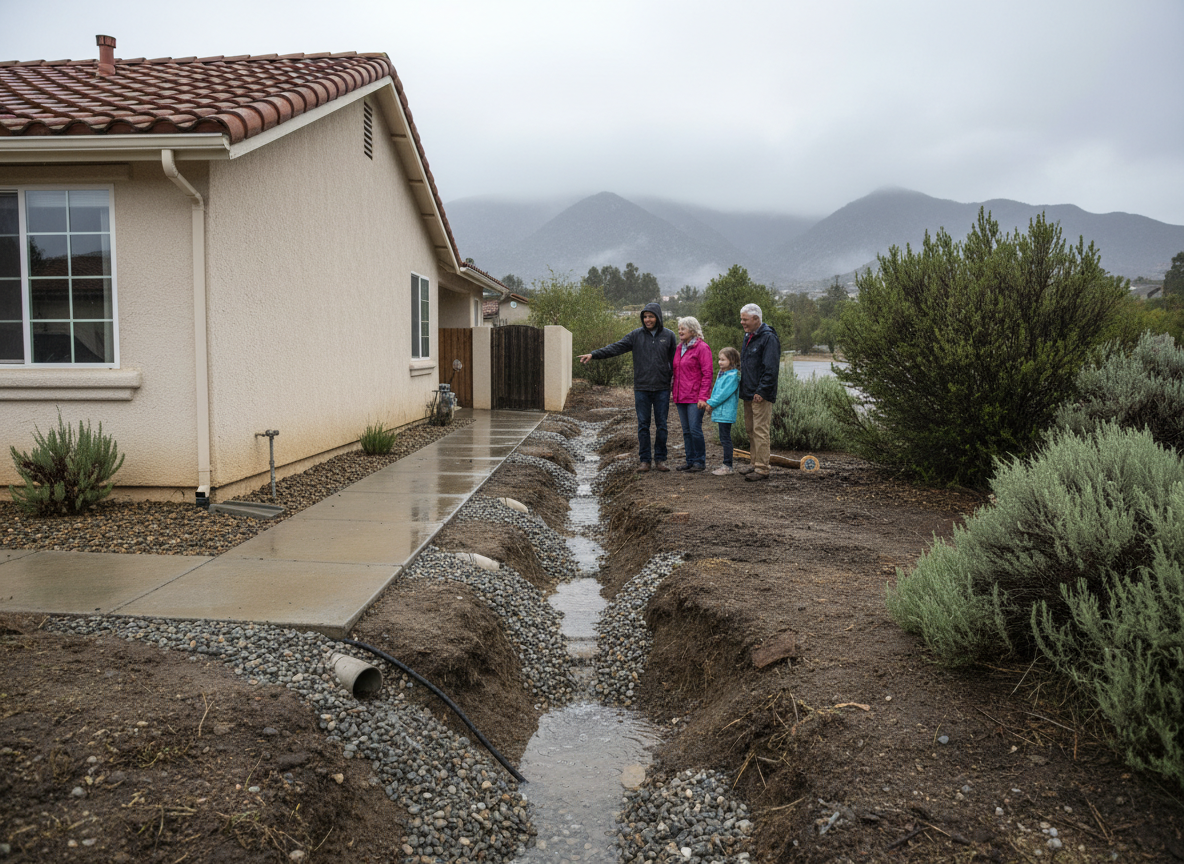
Protecting a San Bernardino foundation from rainwater runoff starts with 3 priorities: keep roof discharge away from the house, maintain a soil or hardscape slope that falls away from the foundation, and provide a dependable outlet for collected water. Where surface grading alone cannot control runoff, French drains, catch basins, or perimeter drainage may be needed. A useful grading target is about 6 inches of fall across the first 10 feet, where the property layout allows, while downspouts should discharge at least 6–10 feet from the foundation without sending water toward a neighboring parcel. The right solution depends on whether the water comes from the roof, a slope, an irrigated area, or runoff crossing the property.
Why San Bernardino Foundations Develop Runoff Problems
San Bernardino’s hot desert climate creates a difficult cycle for residential drainage. Soil around a house can become dry and compacted through very hot summers, so sudden rain may run across the surface instead of soaking in evenly. Water then follows low spots beside foundations, poorly pitched walkways, driveway edges, and old planting beds. Repeated wetting near the structure can erode supporting soil, increase moisture against foundation walls, and enter crawl spaces or low interior areas.
Conditions also vary across San Bernardino County. Properties near Arrowhead and Verdemont may receive runoff from higher ground, while flatter lots in Downtown San Bernardino, Del Rosa, and Muscoy often depend on subtle grading and unobstructed discharge routes. Near California State University San Bernardino, sloped parcels can concentrate water quickly at walls or rear patios. Homes in established neighborhoods may also have additions, replacement driveways, or mature landscaping that altered the original drainage path. The first task is therefore identifying where water begins, where it concentrates, and where it can safely end.
Start With Roof Water And Surface Grading
Roof runoff is usually the simplest water source to trace. During rain, inspect every gutter corner, downspout connection, and discharge point. A downspout that empties beside the stem wall can release concentrated water into one small area, while a buried drainage pipe with a separated fitting may quietly saturate the same location. Extensions must remain positively pitched and should terminate where water can continue moving without returning toward the house.
Check these foundation-protection details:
- Keep gutters clear and correct sections that overflow behind the fascia.
- Extend downspouts 6–10 feet where site conditions permit.
- Maintain approximately 6 inches of fall over 10 feet beside the foundation.
- Seal obvious gaps where patios or walkways meet the structure.
- Avoid creating mulch or soil dams that trap water against the wall.
Hardscape deserves special attention around older, modified properties near San Bernardino City Hall and throughout Downtown San Bernardino. Settled concrete can pitch toward the building even when the surrounding yard appears dry. Water stains, sediment lines, and small erosion channels often reveal the actual route.
When French Drains Are The Right Tool
A French drain is appropriate when water moves through saturated soil or repeatedly collects along a low strip. A typical system uses a perforated 4-inch drainage pipe surrounded by clean drainage stone and separated from surrounding soil with filter fabric. The trench must maintain continuous fall toward a suitable outlet; gravel alone does not correct a pipe that rises, sags, or ends without a discharge point. Proper French drain installation begins with elevations and outlet planning, not excavation.
French drains are less effective for large volumes of fast-moving surface water. A catch basin is generally better beneath a downspout, at a patio low point, or where runoff arrives in a defined stream. In some yards, the dependable design combines catch basins for surface collection with solid drainage pipe for transport and a French drain for subsurface moisture. Soil conditions can change within the same property, so assumptions based only on the neighborhood are risky. The article on French drains for clay soil conditions explains why trench width, stone, fabric, and outlet capacity matter when slow-draining soil is present.
Match The System To San Bernardino Terrain
Drainage design must reflect the path water naturally takes. In Arrowhead and Verdemont, a foundation may sit below a rear slope or beneath an uphill neighbor, making interception above the house more effective than collecting water after it reaches the wall. A properly placed swale or French drain can redirect that flow around the structure, but the outlet still needs enough elevation difference to work by gravity. Residents considering work in the foothill area can review drainage considerations for Arrowhead properties.
On flatter parcels in Muscoy, Del Rosa, and central San Bernardino, limited fall may make the outlet the controlling issue. Extending a pipe across a nearly level yard without checking elevations can create a buried reservoir rather than a drain. Where gravity discharge is impossible, sump pump installation may provide a controlled lifting point, although the basin, pump capacity, power supply, and discharge route must be planned as one system. Similar distinctions apply in nearby Highland, Colton, and Redlands: proximity does not make lot elevations, soil behavior, or available outlets identical.
Inspect Runoff During And After Rain
The best drainage inspection happens while water is moving or immediately after rainfall. Walk the building perimeter without stepping into flowing channels or unstable soil. Begin at the roof outlets, follow each visible stream, and mark puddles that remain after surrounding areas drain. Photograph the water path because dry-weather staining does not always show how several flows combine during a storm.
Look for actionable warning signs rather than waiting for indoor damage:
- Soil pulling away from the foundation during dry weather, followed by water filling the gap during rain.
- Mud, mulch, or gravel deposited against walls and vents.
- Downspouts that bubble, overflow, or discharge through separated fittings.
- Standing water beside the house after other yard areas have cleared.
- White mineral residue, damp odors, or peeling finishes on low interior walls.
A drainage system inspection can establish elevations and distinguish a blocked line from a design problem. Existing systems should also be checked periodically; this guide to maintaining a French drain in San Bernardino covers practical upkeep.
Build A Complete Water Path
Foundation protection succeeds only when every component leads to a safe endpoint. A new trench cannot compensate for overflowing gutters, and a larger drainage pipe cannot overcome an uphill outlet. Before work begins, map the contributing roof area, surface low points, slope direction, utility conflicts, and proposed discharge location. Also consider whether runoff from Glen Helen Regional Park–side terrain or other elevated areas near northern San Bernardino reaches the parcel from beyond its boundaries.
Prioritize corrections in this order: stop direct discharge at the foundation, restore positive surface grading, collect concentrated runoff, and address subsurface water that remains. Keep cleanouts and basin grates accessible rather than burying them beneath decorative rock or dense planting. After installation, test sections with controlled hose flow and inspect the outlet during the next rain.
San Bernardino Drainage is based in San Bernardino and is available Mon–Fri, 8am–6pm, and Sat, 9am–2pm. Whether the property is in Downtown San Bernardino, Arrowhead, Highland, Del Rosa, Muscoy, or Verdemont, the useful question is the same: does every gallon have a continuous downhill path away from the foundation?