2026-08-28 ·
Signs of Poor Drainage in San Bernardino Yards After Winter Storms
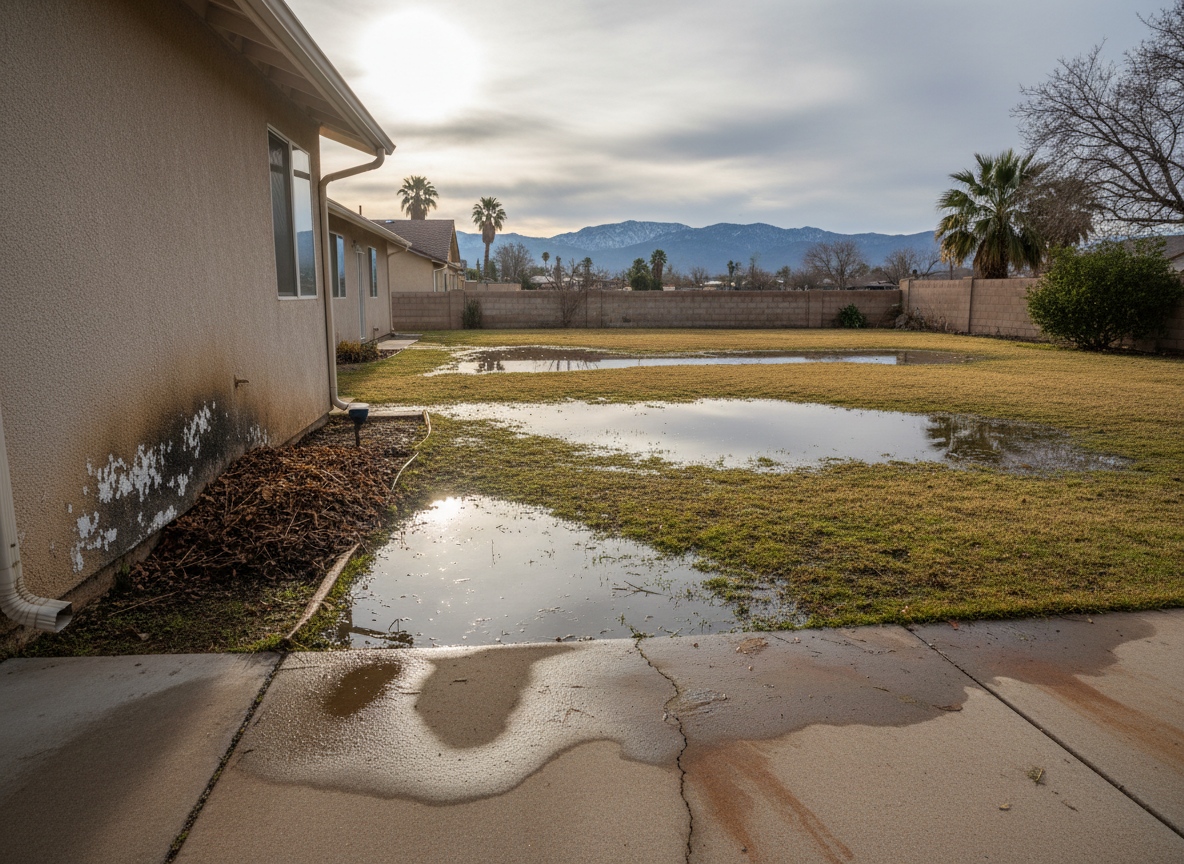
The clearest signs of poor drainage in San Bernardino yards after winter storms are water that remains for more than 24–48 hours, recurring mud, exposed roots, soil washed against walls, and dampness along the foundation or inside low rooms. Also watch for white mineral deposits on masonry, mulch carried downhill, overflowing planters, and unusually green strips that trace a buried drainage pipe. These symptoms matter even if they disappear during San Bernardino County’s long, hot summer because the next concentrated storm can send runoff back toward the same vulnerable areas.
Why Winter Storms Expose Drainage Problems
San Bernardino’s hot desert climate creates a sharp contrast between dry summer conditions and periods of winter rain. Hard, sun-baked ground may accept water slowly when a storm begins, so runoff moves across patios, driveways, compacted side yards, and bare slopes before it can soak in. Several storms close together can also saturate ground that handled the first rainfall without obvious trouble.
Conditions vary across the city. Sloped lots around Arrowhead and Verdemont may collect runoff from higher portions of the property, while flatter parcels in Downtown San Bernardino, Muscoy, Del Rosa, and near San Bernardino City Hall can hold water in shallow depressions. Mixed-age housing also means additions, replacement patios, raised planting beds, and later grading changes may no longer match the property’s original drainage path. Similar problems occur across Highland, Colton, and Redlands: the important question is not merely how much rain fell, but where the water traveled and how long it stayed.
Visible Yard Signs to Check
Walk the property after rainfall has stopped, then inspect it again the following day. A low spot that briefly collects water during a downpour is not automatically a failure; water that remains after surrounding surfaces have dried deserves closer attention.
- Standing water after 24–48 hours: Persistent puddles can damage planting areas and indicate poor grading or slow infiltration.
- Mud in the same path after every storm: A recurring muddy strip often marks concentrated runoff from a roof outlet, slope, or paved surface.
- Rills, channels, and exposed roots: These show that moving water is carrying soil downhill rather than dispersing safely.
- Sediment on paving: Fans of dirt on a driveway or walkway reveal the direction and force of runoff.
- Sunken or unusually green lines: A trench-shaped depression or greener band may point to a damaged or clogged drainage pipe.
Photograph these signs while they are visible. Include downspouts, property edges, and the high and low ends of the yard so a later drainage system inspection can focus on the actual flow pattern.
Warning Signs Near the House
Water beside the building is more urgent than a puddle at the back of the yard. Check the base of exterior walls, crawl-space openings, low windows, garage edges, and transitions where concrete meets soil. Dark masonry, peeling coatings, musty odors, efflorescence, or damp interior baseboards can indicate repeated moisture exposure, even when no water is visibly entering during the inspection.
Pay particular attention to narrow side yards. Roof runoff, air-conditioning pads, fences, and walkways can leave little open ground, creating a channel that directs stormwater toward the rear or front foundation corner. Older properties and remodeled homes may also have patio slabs or landscaping placed too high against the wall. The practical goal is to keep runoff moving away without sending it onto a neighbor’s parcel or trapping it behind edging. Homeowners seeing moisture at the building can review ways to protect San Bernardino foundations from rainwater runoff before choosing a drain type.
When a French Drain Fits the Problem
A French drain is most useful where subsurface water repeatedly saturates a linear area, such as the uphill side of a house, the edge of a soggy lawn, or a low corridor between structures. It typically uses a perforated drainage pipe in a gravel-filled trench to intercept water in the soil and carry it toward a suitable discharge point. It is not a universal answer for every visible puddle.
Fast roof runoff may be better handled by corrected downspout routing or a catch basin at a concentrated low point. Surface grading may be the first issue when water plainly runs toward the house. A French drain also needs a viable outlet and continuous fall; simply burying perforated pipe in the lowest spot can create an underground reservoir. On sloped properties near California State University San Bernardino, Verdemont, or routes toward Glen Helen Regional Park, layout is especially important because runoff can gain speed downhill. See this guide to French drain layouts for San Bernardino sloped properties before planning a trench.
Inspect Existing Drains Before Adding New Ones
If the property already has drains, test and inspect them before assuming another system is needed. Clear leaves, mulch, and sediment from inlet grates, then look for crushed fittings, separated joints, root intrusion, or outlets buried by landscaping. Water surfacing above a buried line, backing up at a basin, or failing to appear at the outlet may indicate a blockage or damaged section.
Avoid sending a full-force hose into an unknown pipe without knowing where it discharges. An abandoned line can release water beside the foundation or beneath hardscape. Existing French drains also lose performance when fine sediment fills the surrounding aggregate or when an outlet becomes obstructed. In those cases, targeted French drain repair may be more appropriate than excavating an entirely new route. Mark each inlet and outlet on a simple sketch, note the direction of slope, and record how quickly test water moves through the system. Those observations make diagnosis far more reliable than inspecting dry ground weeks later.
What to Do After the Storm
Start with evidence rather than immediate excavation. Take photos at the peak of ponding and again at 24 hours and 48 hours; note which roof sections, slopes, patios, and neighboring elevations feed each wet area. Keep soil and mulch below wall finishes, remove debris from visible inlets, and avoid filling a depression until its drainage path is understood. Adding soil in the wrong place can redirect water toward a doorway or adjoining property.
Prompt evaluation is sensible when water reaches the foundation, enters a garage or living area, undermines paving, or repeatedly erodes a slope. Less urgent lawn ponding can still be monitored through several storms to distinguish a one-time blockage from a consistent grading problem. San Bernardino Drainage is based in San Bernardino and is available Mon–Fri, 8am–6pm, and Sat, 9am–2pm. Whether the property is in Arrowhead, Highland, Del Rosa, Muscoy, or Downtown San Bernardino, the useful first step is the same: document where stormwater begins, the route it follows, and where it finally stops.